

You and me and competency
Plus, wonderful wayfinding, grant apps, et plus
First, a confession: I somehow tuned out the whole Artemis II thing, the way I tune out lots of global events, like the Olympics, and the Taylor Swift tour, and is the dress blue or gold. Just as some people don’t have the enzyme to break down alcohol, I don’t seem to have the one to absorb any event that could reasonably be described as epic. But I was lucky enough to be at a cottage with friends who convinced me of the magic of the Artemis’ mission, and we watched together as the Orion capsule safely reentered the atmosphere, to relief and huzzahs and some cute dorky climate lady dancing.
The writer Liz Plank beautifully captures so much of what was so inspiring about the launch in a terrific post you should read in full. But it’s her final point that cut me deep, as I too have been obsessed with this C-word for a few years. Don’t worry, said C-word is not cake.
It’s competence. Writes Liz:
And then there is the competence. This is the part that I think is hardest to admit but most important to say out loud. We have gotten so used to watching the people who are supposed to be in charge fail loudly, fail publicly, fail in ways that feel designed to make us feel small and powerless, that watching four people simply be extraordinary at an extraordinarily hard thing produced in many of us something close to shock. Nobody told me that watching competent people do a hard thing correctly would be the most therapeutic experience of my adult life.
I’ve long been writing this think piece in my brain (yes, this is how I process my thoughts — by arguing with myself as if I’m Statler and Waldorf both): The Competence Crisis. I have no business writing this piece, and would not be competent to do so: I’m not a labour statistician or education PhD. I’m just a human lady who has slowly noticed areas where I assumed there would be deep wells of competence to be wholly devoid of it.
My obsession started years ago when I learned there were basically two firms in all of Canada able to do a very particular kind of energy modelling. Two! On occasion, specific bits of modelling were even jobbed out to two guys in a garage somewhere in New England. I pictured the Car Talk brothers discussing pie charts (Click and Clack, another bickering duo! I’m sensing a theme).
These two firms (and the garage guys) were competent, no doubt, but modelling is based on assumptions, so wouldn’t we want a surfeit of people with deep competency to afford us a range of understanding…especially when modelling out, oh, I don’t know, the energy data on which we base billion-dollar government decisions, many of which inform the future habitability of our planet? This twigged in me an obsession with poking at competency breadth. The knowledge is deep but it must also be wide. Like the river.
In competency research, it seems there’s actually a competency gap as well. (Did you hear the one about the Kafka scholar who kept encountering roadblocks? Sorry not sorry.) There’s no unifying theory, nor agreement on the nomenclature — some scholars study competence (innate, trait-based ability), others competency (skills required to perform a job). The field is patchier than a jacket I’d have bought at Contempo Casuals in 1995. No surprise there are competency gaps everywhere — you can’t improve what you can barely measure.
Three words that keep me up at night: Energy transition competency
We’re in an energy transition, which by definition means new tools and processes are being developed left and right. Meanwhile, governments are stripping the competence out of institutions left and right, too. That’s troubling in the immediate (remember when DOGE fired the last dude who knew how to operate the entire duct-taped computer system that runs the US of A and had to recall said dude?), and a problem long-term: competency takes time, maybe ten years or more — that’s why they hid the number ten in there. You can’t develop it quickly when thousands of people with hard-acquired institutional knowledge are hastily dispersed, their mechanisms of communications and connectivity turned off instantly, like me when I see a man wearing cargo shorts in the cold dead of February.
We have to work hard hard hard to reskill and upskill. And even then we’ll get a lot wrong. If I’m honest (I am, mostly), this is what scares me about the electrotech shift. Almost every electric machine I’ve bought has been installed poorly, or parts of the tech have failed. I was happy to see PM Carney’s investment in the skilled trades in the Spring Economic Statement, but it also made me fret about the difficult task of getting this done right. The contractors who gummed up my heat pump installs weren’t nefarious — they just didn’t have the experience that comes with time and delivers competency. And I don’t know how you shortcut that time without short-circuiting your new electric thingamabob. The competency is in the details.
At the systems level, we know how to build and optimize the grid, but it’s about collaborative competency — the skills to reconcile government, industry, systems, humans. Not rocket science like Artemis II, but…skillful work we also can’t afford to get wrong. All of this requires policy stability, which, due to (put this nicely, Sarah) political opportunism, often suffers. Installers learn the intricacies of government incentive programs just in time for them to be cancelled. Industries orient around new funding only to have it squashed. And churn causes heartburn. So we get a credibility challenge layered atop a competency one.
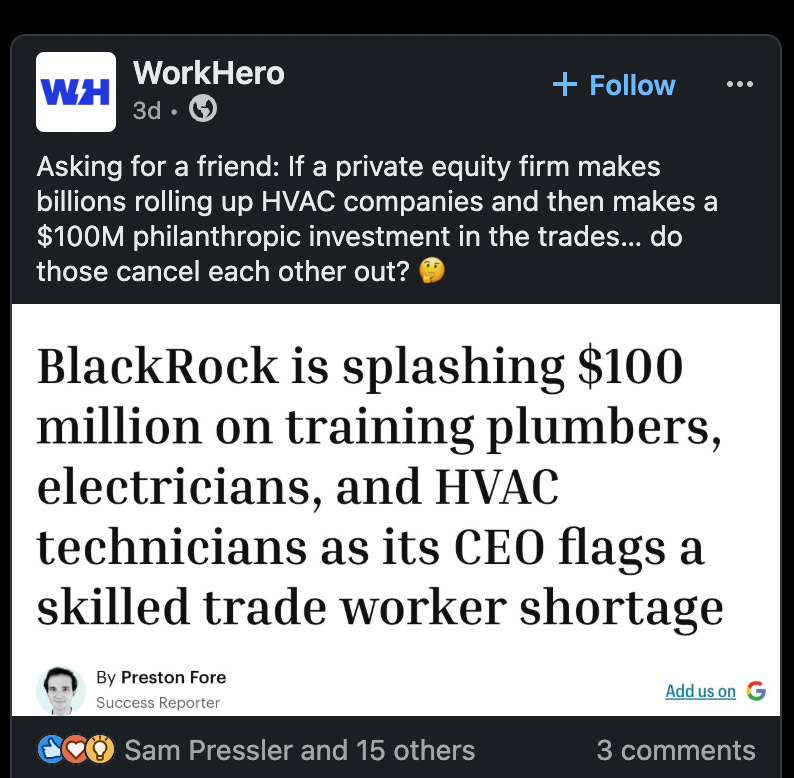
In light of that recent $6 billion announced for skilled trades (what is a skill but a competency honed?), a LinkedIn post from an acquaintance struck a chord — he wrote about being raised in the HVAC industry, yanked out of bed in high school to go on jobs with his dad. He’s been doing this his whole life…what will this new wave of money and training bring? Nada, if we don’t “raise standards, follow through.” It takes a critical mass of leaders with competency enough to usher in that world. I hope to heck we have that layer.
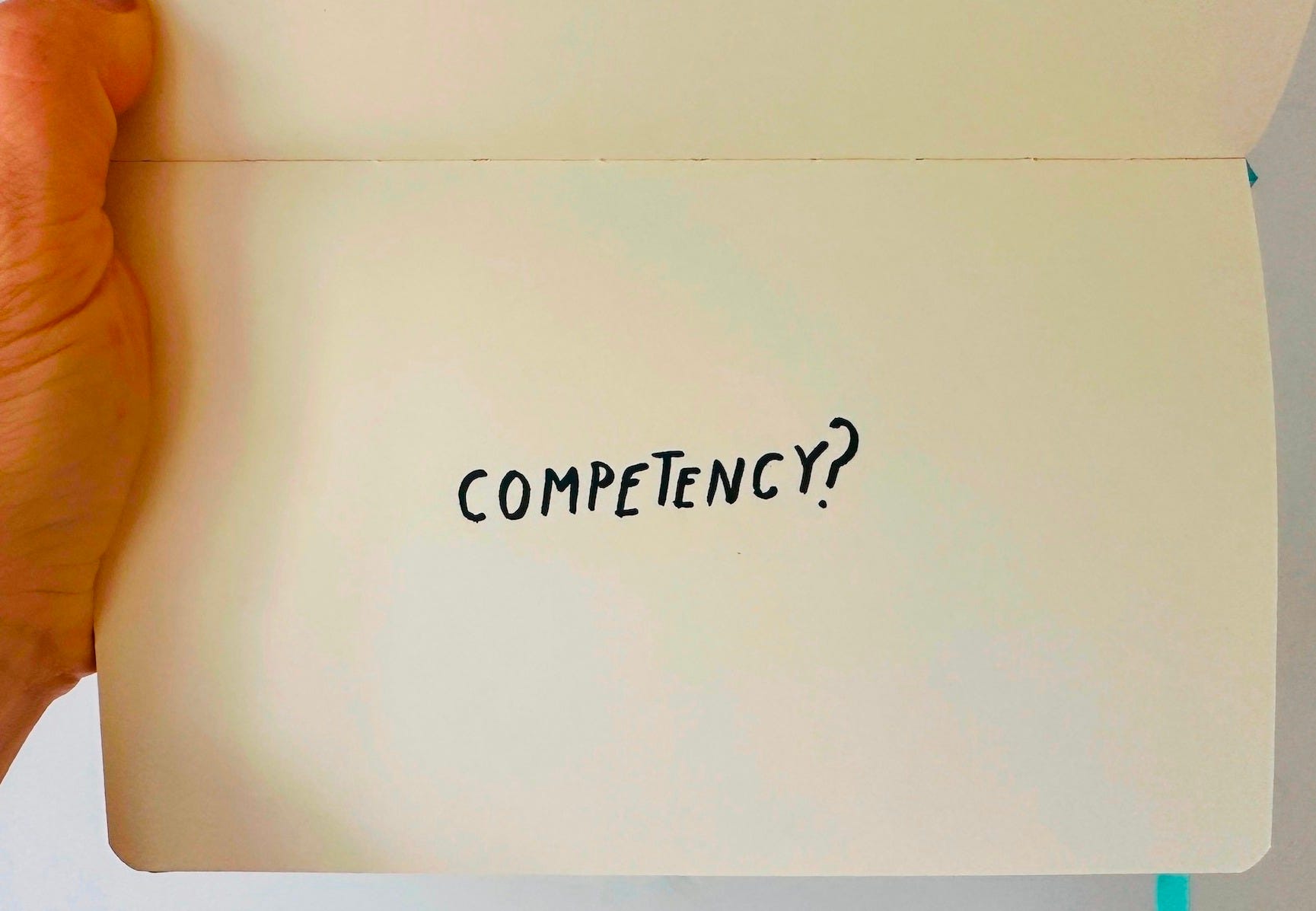
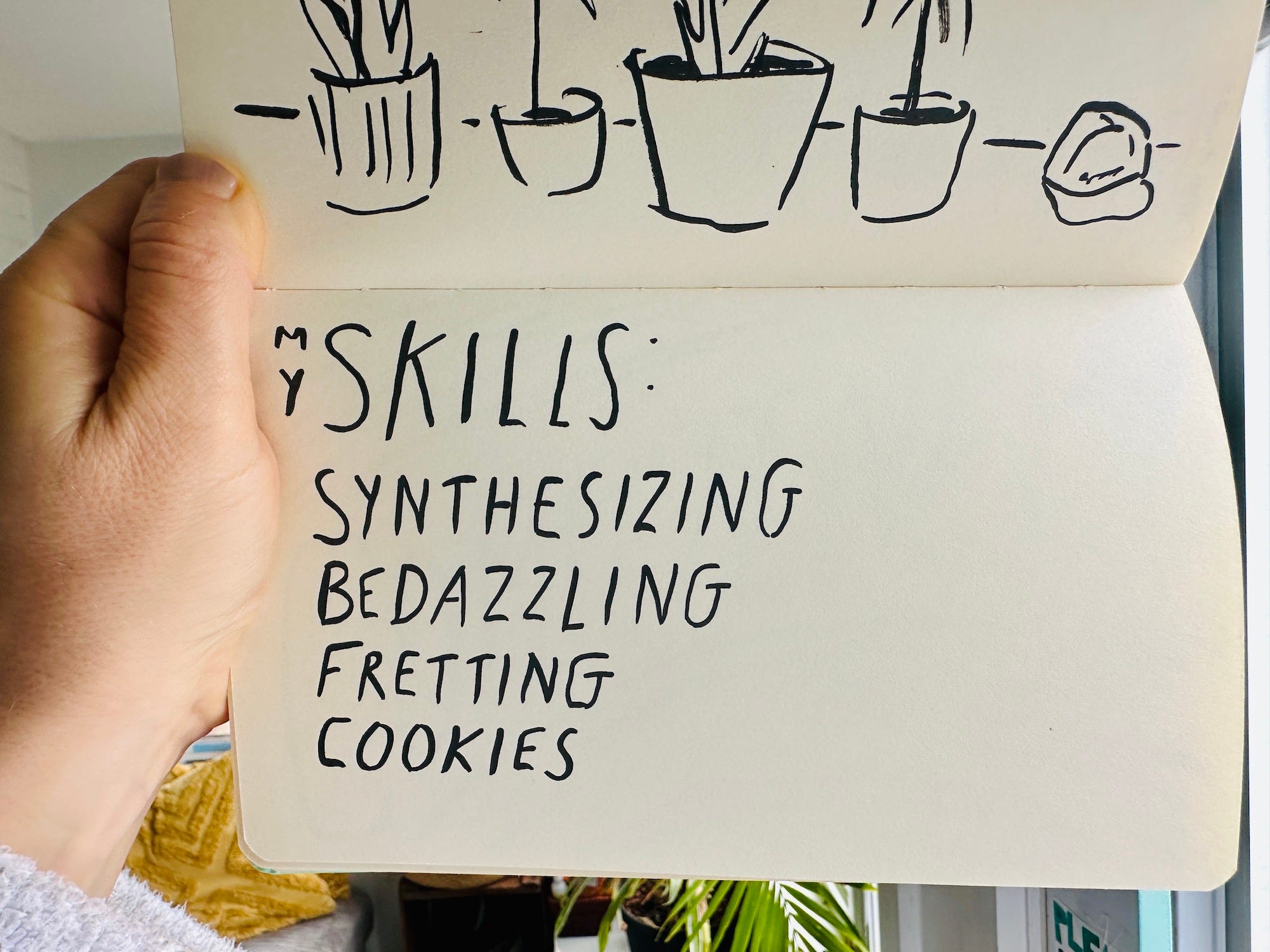
Me, a competency?
Why am I extra competency obsessed right now? Because the world feels competency-depleted. AI presents a facsimile of competency, even as it diminishes our capacity to develop the real thing. Which makes it all the more incumbent on us to double down: What do I do well? What is my sliver of deep competency that helps advance the climate, or decarbonization, or pickleball? But how to get those 10,000 hours/watts/dew drops in a world that no longer hires juniors, or…well, people?
I recently illustrated a book on this subject by two European behavioural scientists (another back-and-forth bantering duo — it’s truly a thing to watch two academics in rimless glasses intellectualize one’s cartoons: highly recommend!), coming soon from MIT Press. They write about competences — the little heuristics that simplify the cognitive overload of modern life. Competency is but a string of competences, rules to live by, strung together. Our subconscious’ microcredentials. We must keep acquiring them to do better by this world.
Competent and confident
When talking about the climate crisis, I often say that we don’t need moonshots or miracles. We know what we need to do, we just need to do it. While that’s true, it sidesteps the fact that knowing what to do isn’t the same as being able to execute and scale. But the pragmatic optimist in me says these are earthly skills. Ones we should be able to acquire and deploy. After all, we know how to send people to the moon!
This planet
What do you notice about competency, or as the kids call it, skillz? (No kids actually call it that.) Let me know!

I can’t believe we’re still talking about not talking about climate. But so it goes. Good thing the excellent folks at Re.Climate put out an amazing report and webinar. Here’s the guide. And here’s me spouting off at their webinar.:
Yale had a great little behavioural science and climate preso last week, and I was most enchanted by this dashboard from the NYU presenters. In looking at dozens of studies of behavioural interventions, they found that “the most consistently effective intervention emphasized both the collective efficacy and emotional benefits of climate action which increased advocacy by up to 10 percentage points (a 30% increase).” It is always thus: Collective power and heart, ftw.
Stuff for you
I am almost as obsessed with wayfinding (or the lack thereof) as I am with competence, so it’s no surprise that I’m deeply enamoured of Dr. Katharine Wilkinson’s beautiful new book: Climate Wayfinding. Katharine has a way of making everything feel human and possible (that’s why her new Substack is called Human on Earth).
Climate Wayfinding provides a beautiful pedagogy for finding our way to doing our best climate work — it’s a book that is also a guide, full of exercises that you can do with others. But you can also just absorb it all, and piece together little practices for yourself, which I’ve been doing for the past week. Plus the design, by Ampersand, takes the book to a whole new level. It’s out May 5th! You know what to do. (And pls do it at your local, independent bookseller if you can.)
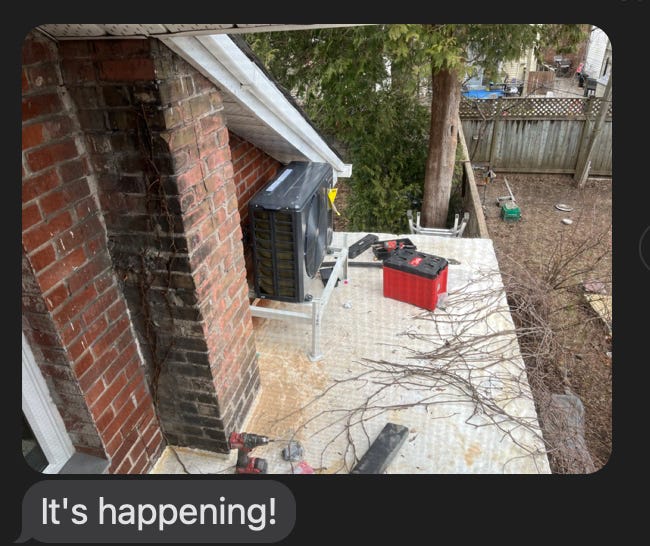
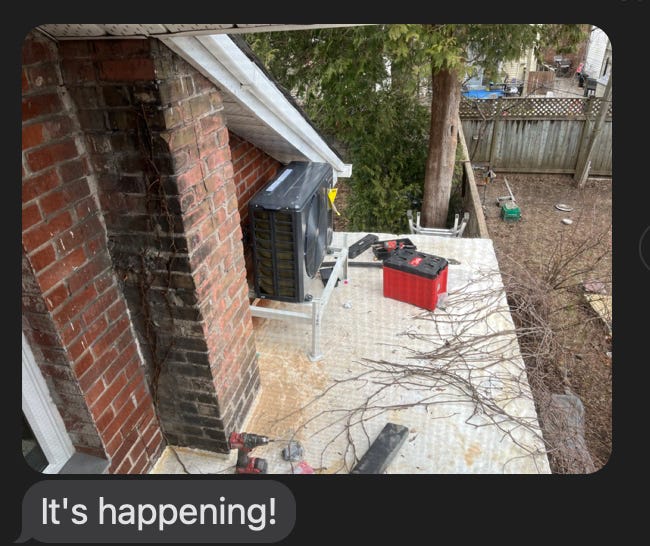
Todd’s heat pump! Every time a friend installs a heat pump a faerie gets its wings. These are my fave texts to receive. Todd’s cute install:
Check out this incredible grant opportunity from Trellis Fund, with an IMMINENT DEADLINE MAY 4th! If you are a female/nonbinary student interested in working in Canada's vibrant clean energy sector, you can get $2500 for education/training. Apply!
Save the date in case I don’t publish a newsletter before May 28th! Seaton Village Green Neighbours is organizing a great evening of electric insight at the Palmerston Library, 6 PMish. I’ll talk electrification with so many smart folks.
Check out my pal Hannah’s gorgeous doc series about Korean seafood and sustainability, Our Ocean Table. She may or may not eat a live prawn.
Wowowow! Ann Arbor installing solar and batteries in people’s homes. LOVE THIS. (Fast Company)
Greenhousekeeping
Thanks, as always, for reading. Let me know how to make this newsletter better. And feel free to send me your thoughts and ideas. If you like this newsletter, please share it. Wishing you health and peace and collective power and heart,
Sarah