

No Climate on a Dead Democracy
Plus, a new electric campaign, more dancing, and a return to analog.
A note: No more iPad drawings for now. My iPad just broke, barely two months out of warranty, and it is unfixable. It’s my third Apple product to break with no ability to be repaired. I no longer believe Apple to be a good steward, Octavia Spencer’s winning performance as Mother Earth notwithstanding. Top that off with Tim Cook cozying up to Brett Ratner, and it’s time for a change. Back to pen and paper, or fingerpainting. (If you have a non-Apple tablet that you love, do let me know!) My husband says I will give up and go back to my beloved Procreate, so I’m using this primo newsletter real estate to hold myself accountable.
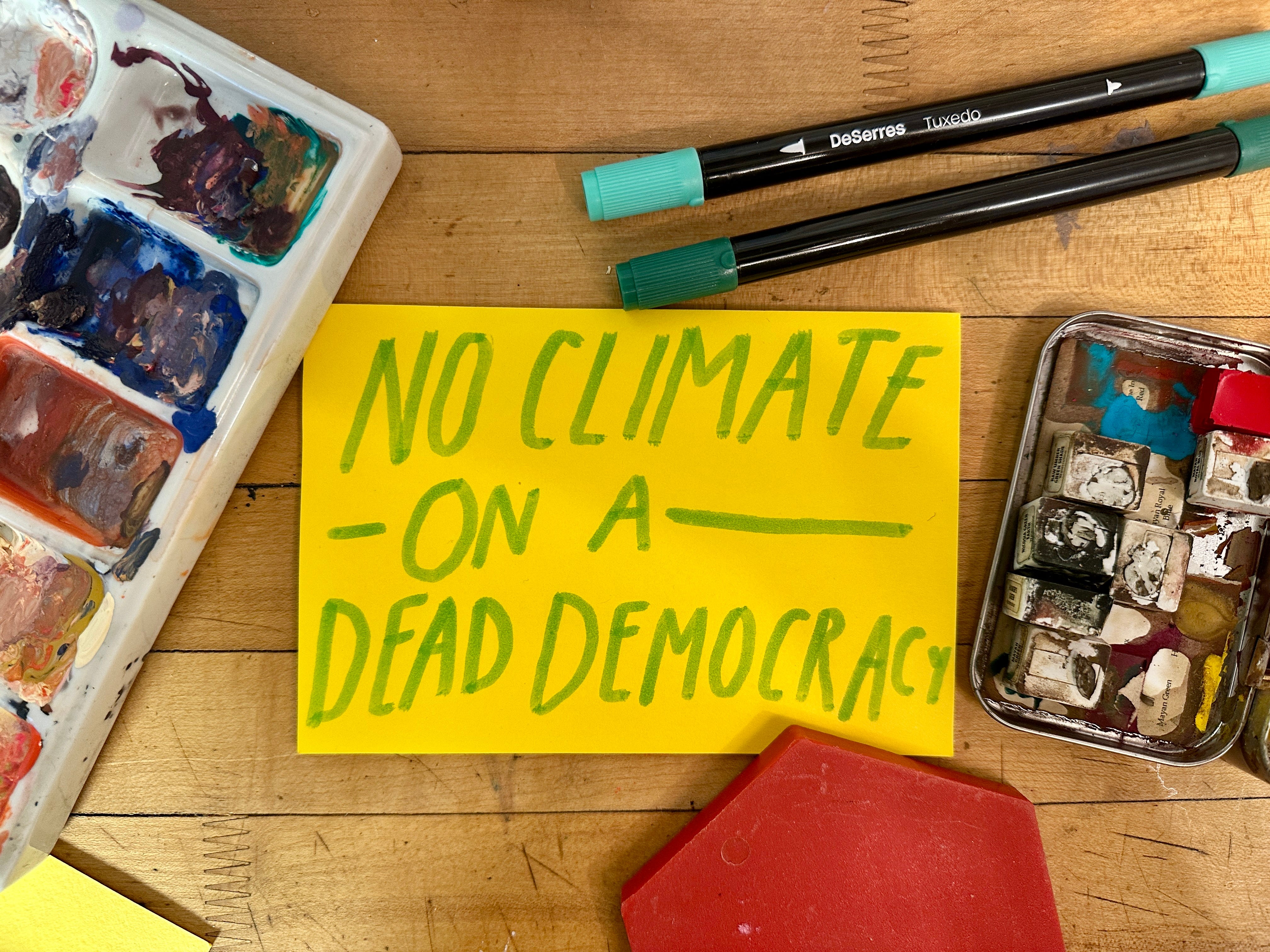
Hello vibrant humans,
Can we even talk about climate now? Normally, it’s all I do. But lately, even I am finding it hard. Sometimes I go into the closet and shout about heat pumps and shipping emissions at the top of my lungs just to get it out. It’s not that I want to talk about all the other terrible stuff more than I want to talk about climate — it’s just that the terrible stuff is consuming my mediaspace, my airspace, my brainspace. Ditto those around me. Some days, I cannot find my way to climate because I’m preoccupied with the health of democracy, or worried others are breaking under the weight of so much violence and stupidity, to the extent that my nattering about the demise of Canada’s EV mandate would be not just unwelcome, but callous. I also feel like I’m waiting, fidgety and frazzly, for something to happen that likely won’t — accountability for all the crimes, deeper shared understanding of just how broken our systems are, a magical act of reset and rebirth. Unlimited kittens.
Many have written far more eloquently than me on how most humans on the planet have existed with threats like this forever, with intense precarity, showing valour and taking action all the while, often with great spirit and energy. But to be kind to myself and meet said frizzy self where it is, I will offer up a frame of generous curiosity: how can we adapt to a world that is more precarious than we might be accustomed to, so that we can continue to do the work and be of service?
We can work to broaden the aperture of acceptable discourse.
For years I felt weird talking about climate, whether in person or on humblebraggy social media sites. Disaffection was deeply bred in the late-Xennial Manic Pixie stew that paraded as my cultural upbringing. That seems so quaint now. Talk about it all. Make Kevin O’Leary angry, Billie Eilish. Rant about gender inequality on Facebook, Girl I somehow know from high school but can’t remember anything about except that you often wore fuzzy antlers. Be unabashed (yet kind) in posing the tough questions, Person who seems wise but may also be a Russian bot.
I see the hedgy caveats on LinkedIn when people talk about what is now happening in the US — I don’t normally post this kind of thing — and I’m so here for it. If you have safety in expressing yourself on public channels, then doing so is especially important. It expands the Overton window for those who have less safety and power to do likewise. At first I thought I didn’t need the caveats, but then I realized they were a perfect example of social proof: I don’t normally do this (but we are not in normal times). With that simple phrase, we break the rules of channels governed by arbitrary norms (link in comments why?) and manipulative algorithms. Nothing is normal. Normal is subjective. And as AI funnels us to sloppish monoculture, not obeying in advance is manifest in the everyday efforts to do things we don’t normally do.
And given that nothingisnormalness, I also think it’s fine to keep doing the work and talking about it. I’ve seen LinkedIn posts where writers chide climate folks for talking about EU emissions reductions while countries are being bombed. I’m a little tired of ‘two things can be true at once (eat a scoop of ice cream every time someone says it),’ but…it’s true.
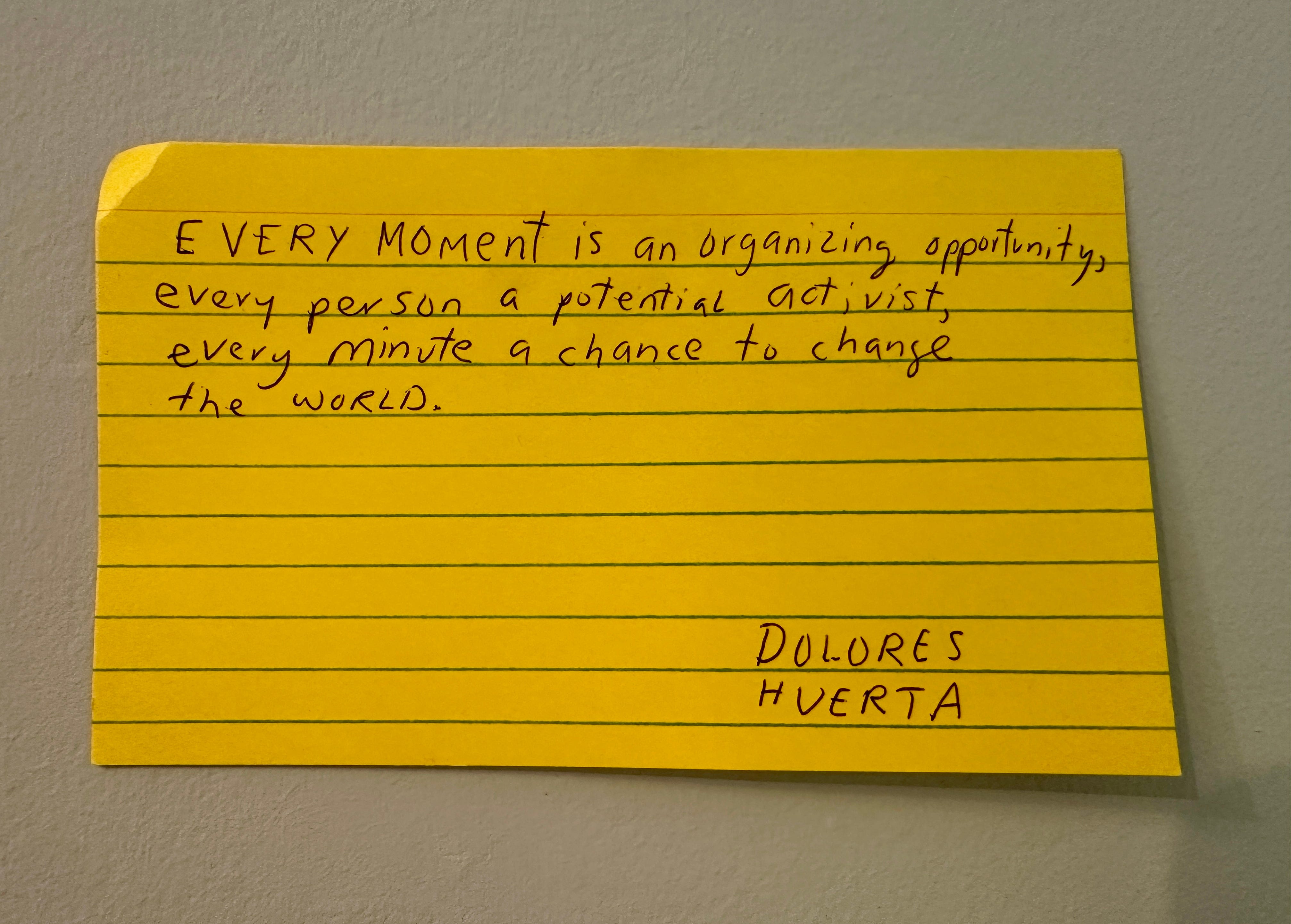
We should not feel guilty for focussing on the fascism
It’s weird that it need be said, but the guilt I feel at reallocating attention or money or energy to non-climate things is real. These resources are largely fungible, but, in my brain anyways, there’s a feeling of guilt. I have only so many dollars, and if they are going to mutual aid in Minnesota, they’re not going to greenbelt defense in Ontario. How effed is that? None of these things should be left to such a fraught individual calculus, like a Kickstarter Trolley Problem. Why do my friends with jobs and healthcare in the US still need to set up GoFundMes? Because we live in an extractive system that has normalized such insanity. Having to stack rank our causes is yet another symptom of this profound brokenness.
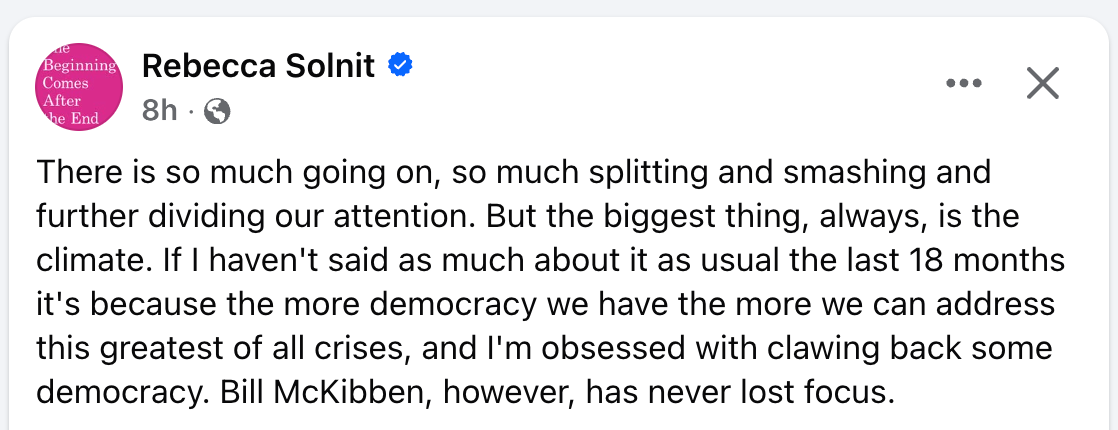
We can remind ourselves that the answer to everything is community and neighbourism.
Writes Garrett Bucks in this absolute banger of a newsletter that you should just go read right now: The skills you and your neighbors need to resist fascism aren’t actually all that hard to learn. What’s going to slow you down is not knowing each other in the first place.
Getting to know each other is how we resist fascism, but also how we fix the park, and share the carpooling, and, ultimately, how we stop climate change. All these neighbour-connecting efforts add up. Writes Bucks: While frequently taken for granted, there’s a reason why the Nordic countries (previously some of the most unequal societies in Europe) were able to transform, in the twentieth century, into some of the most equitable and democratic in human history. It’s because, long before gaining power, they built dense networks of cooperative care infrastructure.
I love that line: dense networks of cooperative care infrastructure. And when I say it, I’m thinking about climate, even if there are no climate-y words in there.
None of these little rules alleviate that feeling that every conversation, action, or post is a negotiation in hierarchies these days. But at the same time, thinking through them has helped me. I’ve always been a person who fixates too much on the mental math of how to spend one’s precious life — should I be taking that dance class or writing that article? Making cookies or making good trouble? These things are not mutually exclusive (I think about making good trouble while I make bad cookies), but in a time where I sometimes feel my mind fraying and decaying, there is only so much time and energy.
Plus, a bonus bit of positive thinking: Civic muscle builds quick
It seems to take me a lot longer to build physical muscle in my 40s than it did in my Popeyed youth. Perhaps that’s why my assumption of late has been that building civic muscle, often from scratch, is difficult or time-consuming or impossible or all of the above. Turns out I am dead wrong on this count. Minnesota has shown that neighbourism is alive and well, and that communities of deep strength can be built almost overnight, when the motivation is protection of people and freedom. Of course, this is not a making lemonade out of lemons kind of story, but is demonstrable proof that, despite the efforts of Broligarchs, and politicians undermining the care economy for decades, people can find these skills inside themselves, and mobilize accordingly: we don’t need to get a PhD in community organizing, though it would be fun. This is good news for saving democracy, and protecting the climate. And it is climate care even if we aren’t talking about climate, because a strong and loving cross-weave of civic muscle is a prereq to climate engagement.
At a conference a few weeks ago a Minnesota climate activist talked about PTA groups raising millions for rent relief, and building massive mutual aid and community democratic defense infrastructure. She also said, in describing her community, ‘we are doing bad, but we are more connected than ever before, more loving.’
We are all doing bad right now, if we’re aware of even an ounce of what’s going on in the world, but we are only connecting, too. My son shoveled our next door neighbour’s house for a few weeks of blizzard, while she returned to Argentina to check on her aging family. She brought him back a box of those gold-wrapped Alfajores as thanks. And then I took two and gave them to my friend and neighbour, who had shared tickets to the ballet for me and my daughter. I like the image of these little gold-foiled delights, being passed from person to person, tiny pulses of sweetness amidst the depravity of these foolish times.
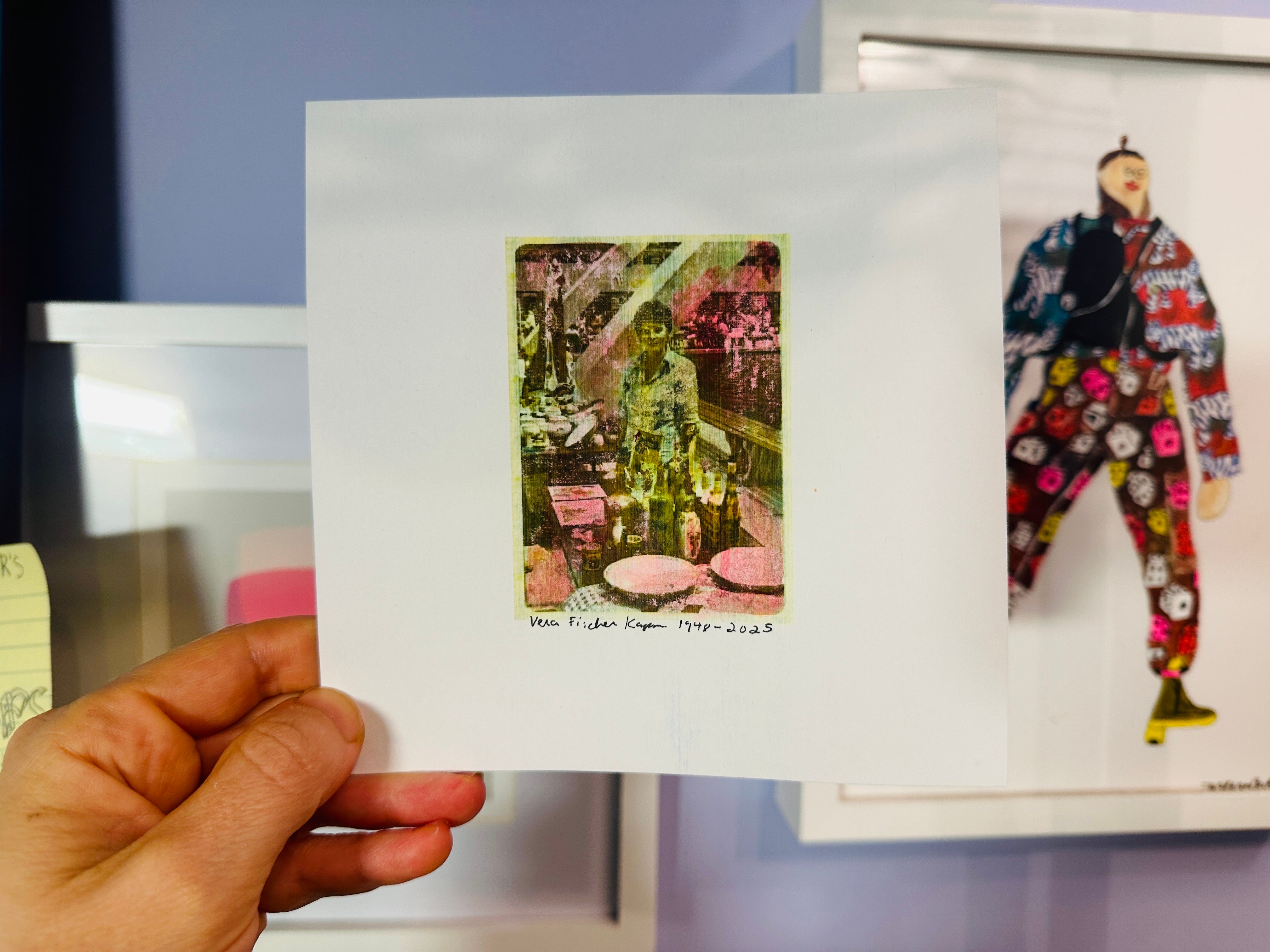
This Planet
Last Planet
Writes reader Arthur Bode, in response to my meandering search for art and balance:
Realizing that finding balance is not a box ticking exercise but a lifelong endeavour is a deep and freeing insight. The sooner in life we all twig onto that bit of wisdom the better off we will all be. There is no one and done on figuring out how to be a decent human being. Recognize and accept that we are and will remain flawed but also know that there is always the possibility, within our reach, of incremental movement toward being better at humaning.
Good grief, that last, beautiful line! Thank you so much, Arthur!

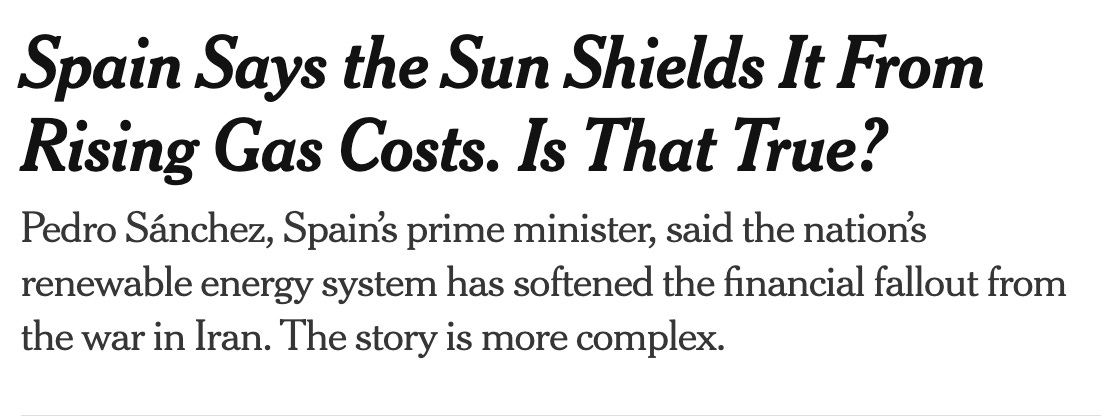
I have probably recommended the Volts pod on reactionary centrism to you at least 3,256 times already, but…it’s one of the best things I’ve heard in a long time, so here I am, recommending it again. The whole pod is about the media/world’s default position of both-sidesist left scolding, unpacked through great examples. Nowhere is this kind of nonsense more evident than the New York Times. This article is a perfect example of it, and I grimaced through my morning coffee reading it.
Stuff + things
Zack Galifianakis has a new gardening show and it looks darn cute!
Cadence Weapon is an amazing musical artist, and ALSO, a great writer and textile savant. The single, Raghouse, on his new album, is a bop. From his terrif newsletter (subscribe!): “Raghouse” is named after the textile recycling facilities where vintage stores find much of their stock. They are cloaked in secrecy. I only managed to get into one after a friend connected me. I had to show up and be vetted in person. The guy’s office was safari-themed. The building was a nondescript warehouse in the middle of nowhere. The rules were as follows: I had three hours to collect a minimum of 100 pounds of clothing for a fee. The clothes rolled onto a conveyer belt and I had to sort through and grab anything of value.
Billionaires made up 19% of US federal campaign contributions in 2024. Yikes.
While the power grabs in the US are more overt, “public accountability is being eviscerated” here in Ontario, as our craven government seeks to weaken our Freedom of Information laws.
Electricuriosities
Electric Living is coming! I’m super excited about this cozy and accessible campaign we’re building at the Building Decarbonization Alliance. Come to a webinar on April 2nd to learn more about how to partner with us! It’s got the most vibrant brand you’ve ever seen, designed by the excellent Geneviève Biloski.
If you’re in Toronto and at CMPX, let a gal know! I’ll be talking a tiny bit about Electric Living at a panel on March 25th.
Hello, induction is finally glam! I’ve been praying for this piece, at my little hot plate induction altar, for years. Thank you, NYT, for doing a darn decent job of it.
Toronto Hydro is giving away big discounts on heat pumps…and great, free coaching! Go go go!
Thank you
As always, thank you for reading, sharing, and sending me comments. I welcome your suggestions for how to make this newsletter better. If you like it, 💚 or share it with any vibrant human you know. I hope you are safe, healthy, and dancing.
People dancing
H/t to my friend Ian for sending this to me. He’s also started a brand new climate coalition to better utilize the grid. Check it out.
Thank you for sending me this, friend who shall remain nameless:
Need some chill beauty?
Thank you for this. Linking back to Climate and the current debacle to the South of you, there is a bright spot.
Our Fearful Narcissist has instituted a plan - likely fed to him by his oil buddies - to enshrine oil and gas and coal in the U.S. energy mix for the next generation. “The Problem Is…” Solar and Wind are faster and cheaper to stand up - today - than coal or oil. And depending on price, they’re cheaper than gas as well, and still faster to set up. And they’re scalable. Market forces are more powerful than even ‘Oiligarchs’.
[I grew up as a bureaucrat, and made my career from “but the problem is…” It took retirement to show me that I needed to focus on, “and the opportunity is…]🙏
Beatutiful post and amazing jazz. Beauty is something those war in suit men would never be able to enjoy. Let's hope we can talk about climate again soon.